
Every joint, made exactly the same way
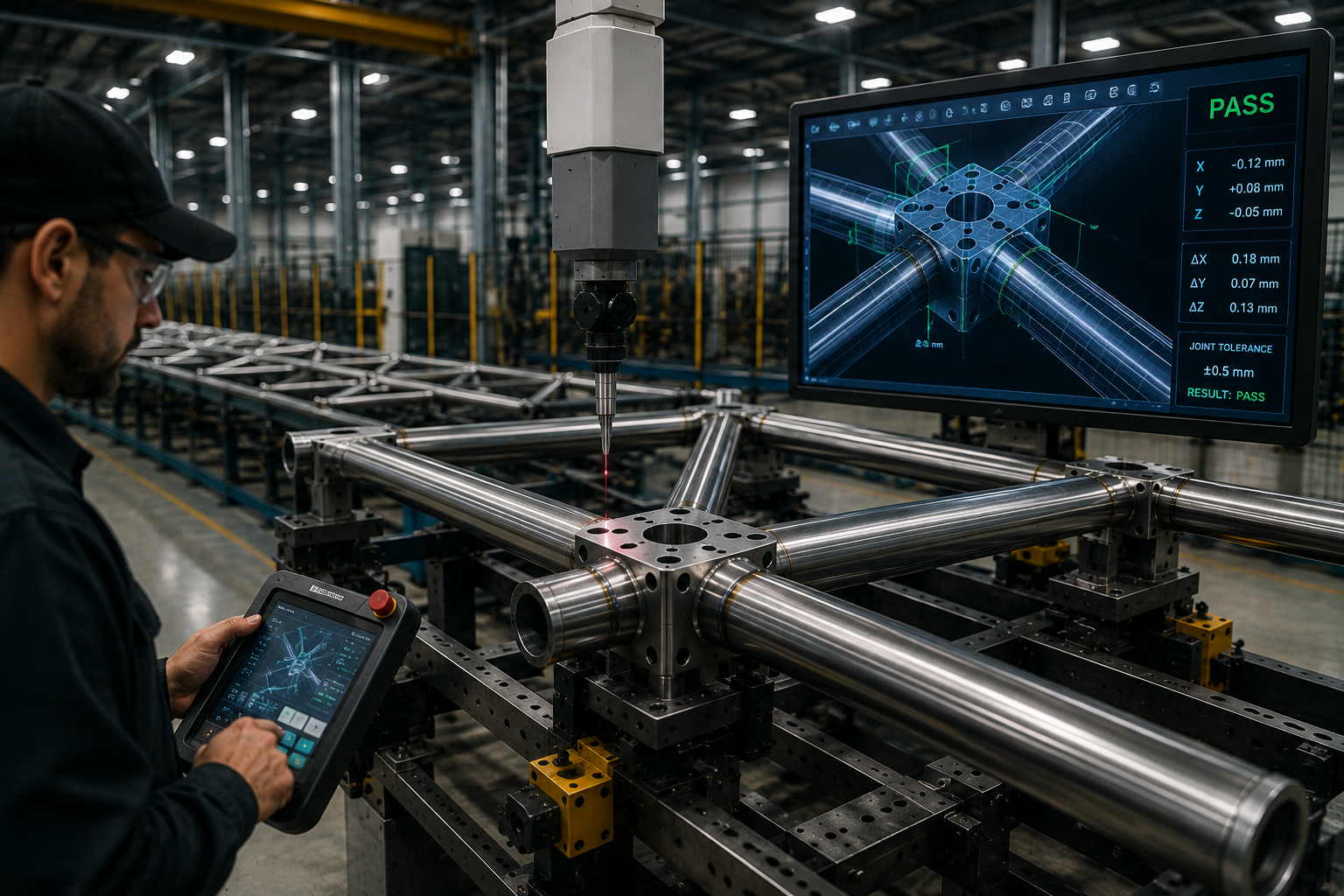
A 6-axis robotic arm fabricates every SmartFrame structural joint to ±0.5mm tolerance, the same precision on unit one and unit four hundred. That's why our panels arrive ready to assemble, not ready to modify.
A machine built to reach any angle
A 6-axis robot is built around six independently controlled rotational joints, stacked from a fixed base to a rotating wrist. Together they give the arm six degrees of freedom, meaning it can place its tool at almost any point in its working envelope, in almost any orientation. A space frame is not a flat assembly. Its nodes are the points where several structural members meet at angles dictated by geometry, and a 6-axis arm can rotate around a stationary node and change its approach angle for each connection in sequence, without ever moving or reclamping the part.
Precision measured in fractions of a millimeter
Industrial 6-axis robots, evaluated under standards like ISO 9283, commonly hold repeatability in the range of a few hundredths of a millimeter, arm to arm and cycle to cycle. That headroom is why Karlev can commit to ±0.5mm on every SmartFrame joint, and hold it as a floor rather than a best case. Structurally, that consistency matters because a space frame carries load through its joints, not around them. If one connection sits looser than its neighbors, load doesn't distribute the way the engineering assumed.
One model, one path
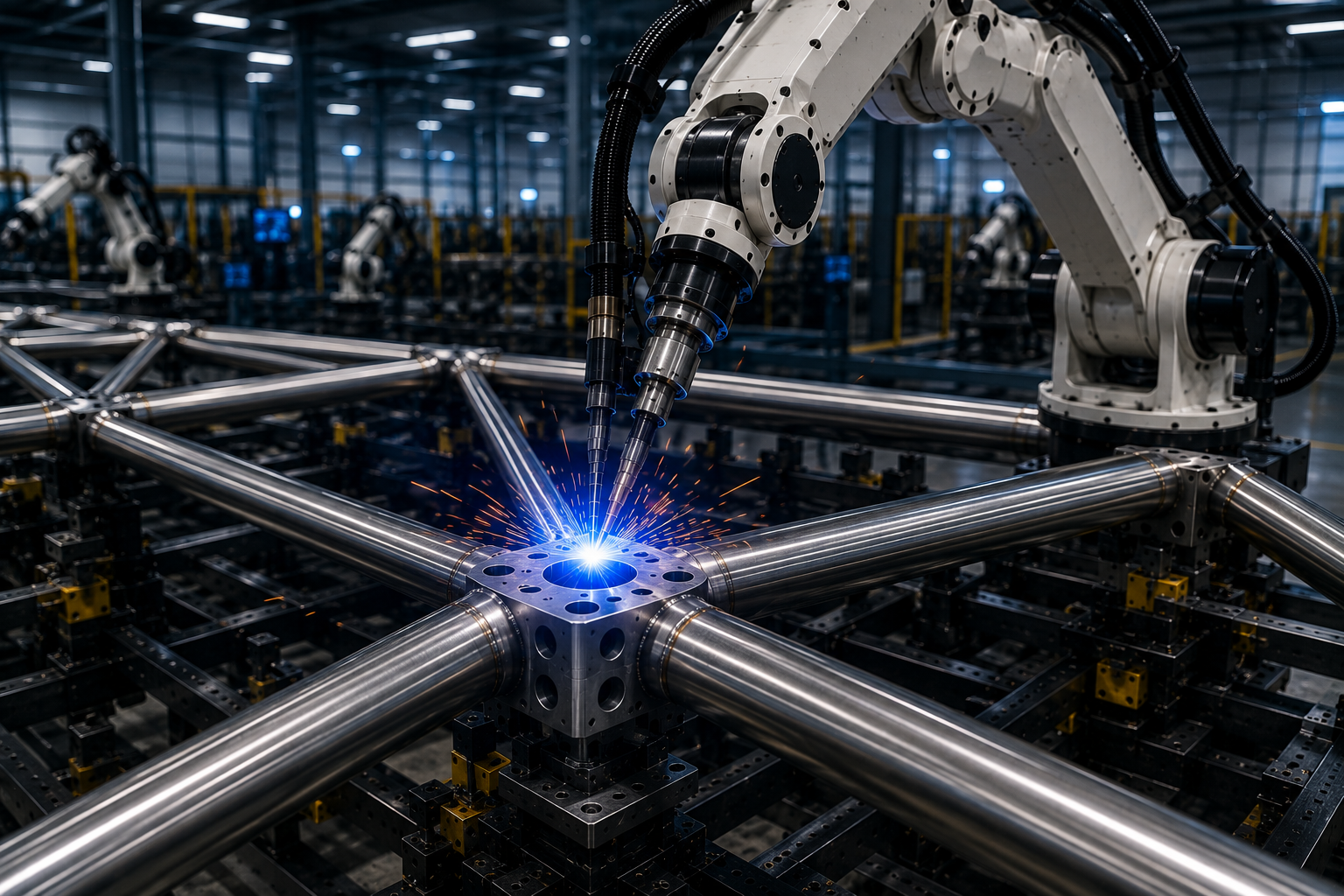
The geometry of a SmartFrame structure is defined once, in a single coordinated digital model. That same model is the source for the robotic arm's toolpath. A drawing read by a person on a shop floor gets interpreted, and interpretation leaves room for small deviations to compound across hundreds of joints. A toolpath generated directly from the design model isn't interpreted. It's executed.
Same weld, unit one to unit four hundred
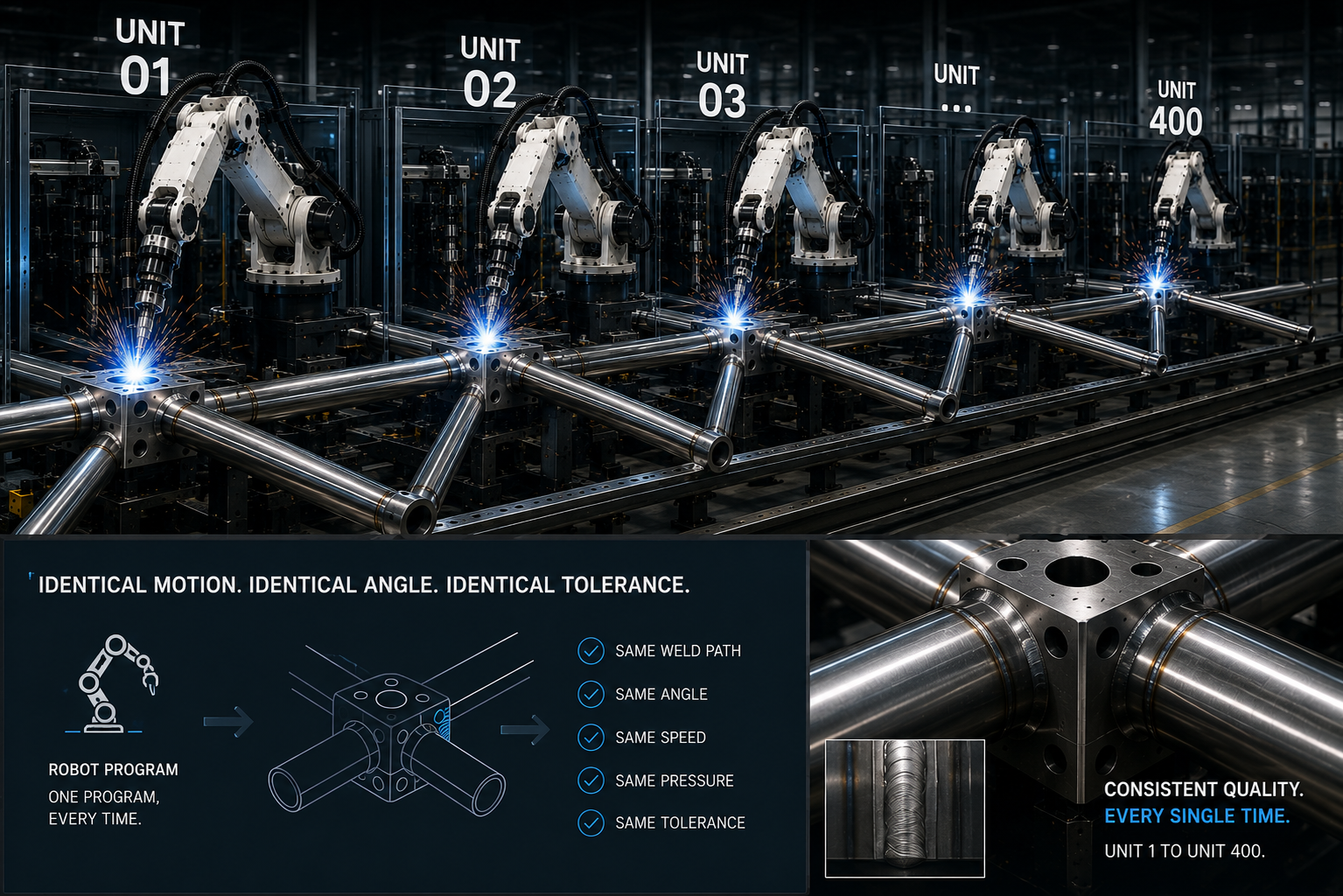
Manual welding is a skilled trade, and skill varies, hour to hour and person to person. High-volume manufacturing solved this problem decades ago by putting robots on the repetitive, precision-critical joins. A SmartFrame joint is held to the same logic. The robotic arm doesn't have a good day or a bad day. It performs the identical motion, at the identical angle, to the identical tolerance, whether it's fabricating the first 400 SQFT one-bedroom we ever built or the four-hundredth 1,200 SQFT three-bedroom home.
Built without waiting for weather
Field construction runs on the schedule the world allows it. Rain stops a weld. Darkness stops a crew. A factory floor is a controlled environment, and a robotic fabrication process inside it isn't interrupted by weather, daylight, or the logistics of getting equipment to a job site.
Where people come in
None of this runs itself. Skilled technicians program every toolpath before a robotic arm ever moves, calibrate the equipment, and monitor the process while it runs. When a joint is complete, a person inspects it. The robot performs the repetitive, precision-critical motion with a consistency no hand can fully match, but judgment, setup, and quality verification stay with people.
From our experts
Straight from the Karlev engineering team:
Ready to build together?
Talk with Karlev about bringing this technology to your project.